
Strait of Hormuz Map:
Complete Guide for 2026
Every Iranian port, UAE city, and Omani enclave on the map — plus who controls the strait, why it matters, and what the Iran–USA conflict means for global oil.
What Is the Strait of Hormuz?
The Strait of Hormuz is a narrow waterway connecting the Persian Gulf to the Gulf of Oman and, beyond it, the wider Arabian Sea and Indian Ocean. It is the world’s single most important oil transit chokepoint — a sliver of ocean roughly 34 kilometres (21 miles) wide at its narrowest point, bordered by Iran to the north and the Musandam Peninsula of Oman to the south.
The strait stretches roughly 167 kilometres (104 miles) in length, with width varying from about 97 km at its widest to just 34 km at its most constricted point. Two opposing one-way shipping lanes, each about 3.2 km wide, thread through this narrow passage every day, carrying supertankers laden with crude oil from Saudi Arabia, Iraq, the UAE, Kuwait, Qatar, and Iran itself to markets around the world — primarily in Asia.
Strait of Hormuz Map: Full Geography
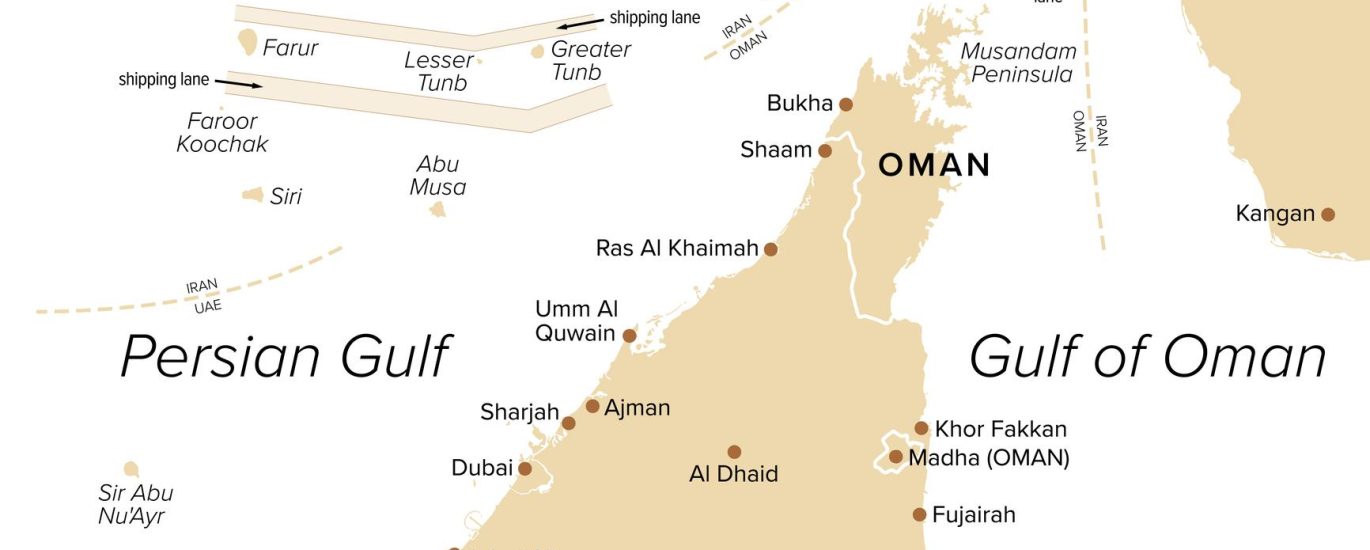
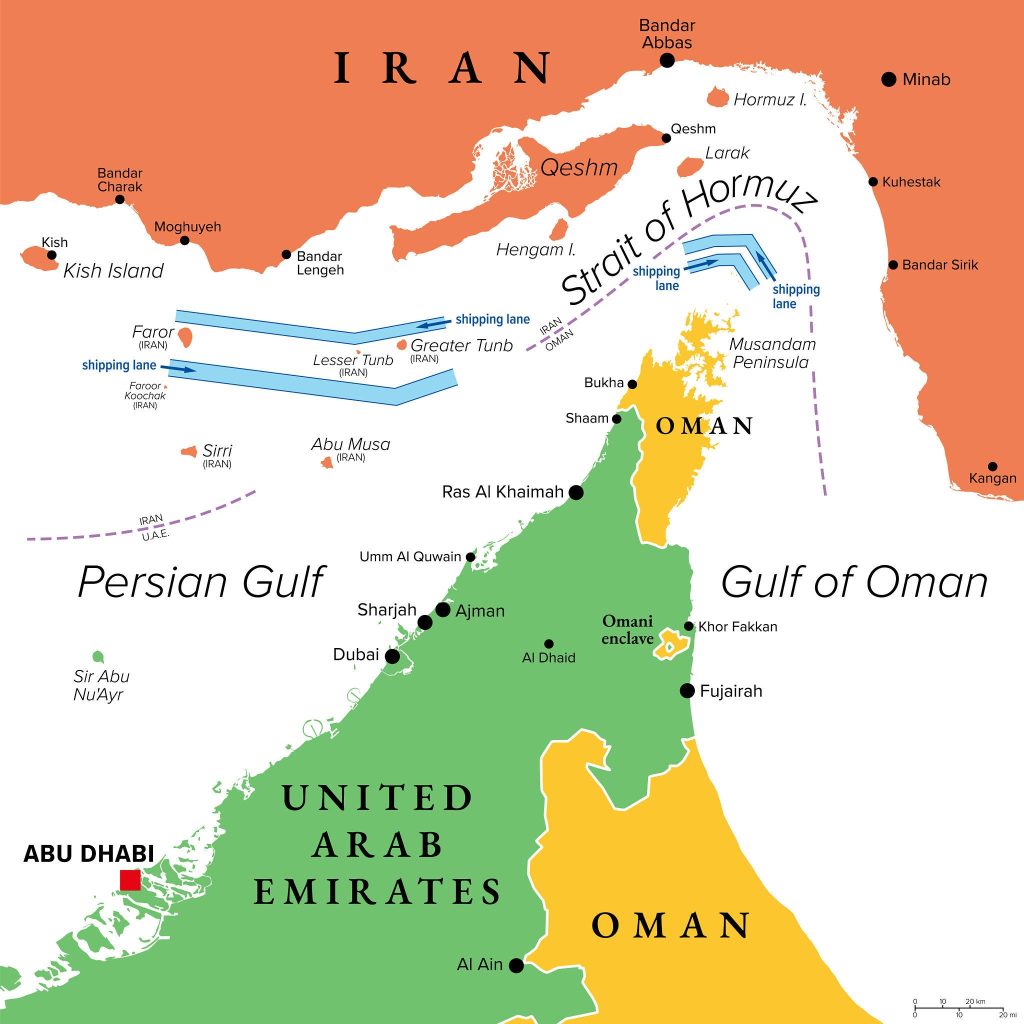
The map below shows all the major Iranian ports, islands, and cities bordering the Strait of Hormuz and the northern Persian Gulf, the UAE coastal cities to the southwest, and Oman’s Musandam Peninsula forming the strait’s southern jaw. Use this as your reference guide.
🗺 Strait of Hormuz — Annotated Map
Schematic map — not to navigational scale · HormuzMonitor.com · 2026
Iran’s Ports, Cities & Islands Bordering the Strait
Iran holds the entire northern shore of the Strait of Hormuz, giving it strategic dominance over the chokepoint. Below is a complete reference to every significant Iranian location along the strait and the adjacent Persian Gulf coast, as shown on the Strait of Hormuz map:
| Location | Type | Strategic Significance |
|---|---|---|
| Bandar Abbas | Major Port City | Iran’s most important commercial port and home to the IRGC Navy’s main base on the strait. Gateway for a large share of Iran’s imports and exports. |
| Qeshm Island | Large Island | Iran’s largest island; free trade zone, strategic naval positioning point, sits directly at the strait’s mouth. |
| Hormuz Island | Island | The island that gives the strait its name; historically a key trading fortress; overlooks the narrowest point of the strait. |
| Kish Island | Island / Free Trade Zone | A major Iranian free trade and tourism zone; lies in the lower Persian Gulf, symbolically and economically important. |
| Hengam Island | Island | Small island with IRGC presence, used for surveillance and fast-boat operations near the strait entrance. |
| Larak Island | Island | Used for oil storage and naval operations; close to the strait’s narrowest point. |
| Bandar Lengeh | Port Town | Historic trading port; smuggling hub and fishing town west of the strait entrance. |
| Bandar Charak | Port Town | Small port town and fishing village west of Bandar Lengeh. |
| Minab | City | Inland city near Bandar Abbas; hinterland supply hub for the naval port. |
| Kuhestak | Town | Coastal town east of Bandar Abbas toward the Gulf of Oman. |
| Bandar Sirj | Small Port | Remote coastal settlement east of Bandar Abbas. |
| Kangan | Town / Gas Hub | Located near South Pars gas field; significant for LNG infrastructure. |
| Moghuyeh | Village / Coastal Point | Small coastal settlement between Kangan and Bandar Charak. |
| Farror / Sirri Island | Island / Oil Terminal | Sirri Island hosts an Iranian oil terminal in the western entrance of the strait zone. |
| Abu Musa Island | Contested Island | Controlled by Iran, claimed by the UAE; hosts an Iranian military garrison and lies near key shipping lanes. |
| Greater Tunb | Contested Island | Seized by Iran in 1971, claimed by the UAE (Ras Al Khaimah); gives Iran a military observation and missile platform in the strait. |
| Lesser Tunb | Contested Island | Uninhabited island also seized from the UAE in 1971; provides Iran additional presence in the strait. |
UAE Cities & Ports on the Strait of Hormuz
The United Arab Emirates occupies the southwestern shore of the Strait of Hormuz and much of the lower Persian Gulf coast. The seven UAE emirates are, from west to east:
| Emirate / City | Coast | Key Port / Role |
|---|---|---|
| Abu Dhabi | Persian Gulf | UAE capital; home to Jebel Ali’s sister terminals, Zayed Port, and the start of the Abu Dhabi Crude Oil Pipeline (ADCOP) bypass route. |
| Dubai | Persian Gulf | Jebel Ali Port — one of the world’s largest container ports; major re-export hub for the region. |
| Sharjah | Persian Gulf + Gulf of Oman | The only emirate with coastlines on both sides; Khalid Port on the Gulf side. |
| Ajman | Persian Gulf | Smallest emirate; Ajman Port handles regional trade. |
| Umm Al Quwain (UAQ) | Persian Gulf | Small emirate with a natural creek harbour; light fishing and trade. |
| Ras Al Khaimah (RAK) | Persian Gulf / Strait approach | Northernmost UAE emirate; closest to the strait entrance; claims Greater and Lesser Tunb islands from Iran. |
| Shaam | Strait / Gulf of Oman | Small coastal settlement of Ras Al Khaimah on the eastern (Gulf of Oman) side, near the Musandam border. |
| Khor Fakkan | Gulf of Oman (Sharjah exclave) | Deep-water port on the Gulf of Oman side — a key alternative to strait-side ports; container terminal bypasses strait congestion. |
| Fujairah | Gulf of Oman | Critical oil bunkering and storage hub; eastern terminus of the UAE’s ADCOP bypass pipeline; Fujairah Port handles supertankers. |
| Sir Abu NuAyr | Persian Gulf (island) | UAE-controlled island in the middle of the Persian Gulf; strategic military and maritime monitoring position. |
Oman & the Musandam Peninsula
The southern jaw of the Strait of Hormuz is formed by Oman’s Musandam Peninsula — a dramatic, mountainous exclave separated from the main body of Oman by the UAE. The peninsula juts northward into the strait like a finger, with fjord-like inlets called khors cutting deep into its cliffs.
The Musandam Governorate
The Musandam Peninsula forms its own governorate within Oman. It is one of the most strategically positioned territories on earth — Oman’s coastline here defines the southern shipping lane of the strait. The key locations on the Omani side include:
| Location | Description |
|---|---|
| Musandam Peninsula | The mountainous Omani exclave forming the strait’s southern coast; sometimes called “the Norway of Arabia” for its dramatic fjords (khors). |
| Buhka (Bukaah) | Small Omani coastal settlement on the peninsula’s eastern face overlooking the Gulf of Oman entrance to the strait. |
| Omani Enclave (Madha) | A separate Omani exclave within the UAE, surrounded on all sides by Emirati territory — one of the world’s most unusual geopolitical oddities. |
| Gulf of Oman | The body of water east of the strait connecting it to the Arabian Sea and the wider Indian Ocean. Ships exiting the strait enter the Gulf of Oman. |
Oman maintains a neutral, trade-focused foreign policy and has historically played a back-channel diplomatic role between Iran and the West. This unique position means Oman has repeatedly served as a mediator during Hormuz crises, including during the 2015 Iran nuclear deal negotiations.
Why Is the Strait of Hormuz So Important?
No other single chokepoint on earth concentrates so much of global energy trade in such a narrow passage. Here is why every government, oil trader, and navy in the world watches it:
1. Volume of Oil
In 2024, roughly 20 million barrels of oil per day flowed through the strait — approximately 20% of all the petroleum liquids consumed globally and more than a quarter of total seaborne oil trade. Saudi Arabia alone accounted for 38% of crude flows, followed by Iraq, the UAE, Kuwait, and Qatar. The biggest destination markets were in Asia: China, India, Japan, and South Korea together received around 69% of all crude passing through.
2. LNG Trade
Around one-fifth of all global liquefied natural gas (LNG) trade also transits the strait — primarily from Qatar’s South Pars / North Dome field, the world’s largest gas reservoir. There is no pipeline alternative for LNG; it can only leave the Gulf by ship.
3. No Meaningful Bypass
Almost uniquely among global chokepoints, the Strait of Hormuz has very limited bypass options. Only Saudi Arabia’s East-West Pipeline (up to ~5 million b/d) and the UAE’s ADCOP to Fujairah (up to ~1.5 million b/d) can partially bypass it — together covering perhaps 3.5–5.5 million b/d of spare capacity, far below the 20 million b/d that normally transits. All Qatari LNG, all Kuwaiti oil, all Iranian oil, all Bahraini and most Iraqi exports must pass through.
4. Global Food Security
The Persian Gulf is also the world’s largest hub for fertiliser exports. Disruption to the strait affects food production globally, not just fuel prices.
Who Controls the Strait of Hormuz?
There is no single legal “controller” of the Strait of Hormuz. Under UNCLOS (the UN Convention on the Law of the Sea), vessels have the right of “transit passage” through international straits — meaning warships and commercial ships may pass freely without permission from the bordering states.
In practice, however, the question of effective military control is much more contested:
Iran’s Position
Iran controls the entire northern shore — roughly 1,500 km of Persian Gulf and strait coastline. It operates multiple naval bases along this coast, most importantly at Bandar Abbas. Its Islamic Revolutionary Guard Corps Navy (IRGCN) deploys thousands of fast attack craft, anti-ship missiles on mobile launchers positioned throughout the Strait of Hormuz map area, submarines, and — critically — mines. The US Defense Intelligence Agency estimated in 2019 that Iran possessed over 5,000 naval mines deployable via high-speed boats. Iran also occupies Abu Musa, Greater Tunb, and Lesser Tunb — islands positioned directly in the shipping lanes.
The US Navy
The United States Fifth Fleet, headquartered in Bahrain, has historically been the dominant naval force in the broader Persian Gulf region. The US has argued for “freedom of navigation” in the strait and regularly deploys carrier strike groups and destroyers in the region. However, the 2026 crisis has shown the limits of US naval power against an adversary using asymmetric tactics — mines, swarm boats, and shore-based missiles — in the world’s most confined international waterway.
Oman’s Role
Oman controls the southern shore through the Musandam Peninsula and, as a sovereign state on the strait, has legitimate interests in freedom of navigation. Oman has generally remained neutral and has hosted diplomatic back-channels.
Is the Strait of Hormuz Open or Closed Today? (April 2026)
Key Events Timeline (2026 Crisis)
For the most current situation, the Hormuz Strait Monitor provides real-time tracking of ship transits, oil prices, and stranded vessels.
Why Are the USA and Iran Fighting Over the Strait of Hormuz?
The US–Iran conflict over the Strait of Hormuz is decades old, but the 2026 crisis represents its most acute escalation. To understand it, you need to understand three overlapping conflicts: nuclear, regional hegemony, and financial.
1. The Nuclear Dimension
Tensions between the US, Israel, and Iran escalated sharply following the collapse of nuclear negotiations in Geneva. Alongside a prior 12-day air conflict in 2025, failed diplomacy led to the US and Israel launching air strikes on Iranian military and nuclear infrastructure on 28 February 2026 — triggering the current crisis.
2. Regional Power
The US has maintained military dominance in the Persian Gulf since the 1980s, backing Gulf Arab states (Saudi Arabia, UAE, Kuwait) against Iranian influence. Iran, meanwhile, has built an extensive network of proxies across the region (Hezbollah, Houthi, Iraqi militias) and views US military presence as an existential threat. The Strait of Hormuz is Iran’s single most powerful asymmetric lever against US power projection.
3. The Financial / Petrodollar War
This is arguably the deepest layer of the conflict — and the one most consequential for the entire world. (See the Petrodollar section below for the full explanation.)
Why Iran “Hangs On” to the Strait
For Iran, the Strait of Hormuz is the ultimate deterrent. Controlling it — or threatening to close it — gives Iran leverage that no amount of sanctions can neutralise. It is the one card that can spike global oil prices, threaten the US dollar’s reserve status, and force Asian powers (especially China) to choose between Washington and Tehran. Iran has invested heavily in layered denial capabilities: mines, swarm boats, shore-based missiles, and island fortifications precisely to make the strait militarily costly for any adversary.
Why the USA “Hangs On” to the Strait
For the US, losing control of the strait would mean losing control of the petrodollar system — the financial architecture that has underwritten American economic dominance since 1974. A closed strait, or a strait where China collects yuan-denominated transit fees, is not just an energy crisis: it is a direct challenge to the dollar as the world’s reserve currency and to US Treasury bond demand.
The Petrodollar Explained — And How the Strait of Hormuz Threatens It
What Is the Petrodollar?
The petrodollar system is the arrangement — formalised in 1974 through a secret agreement between the US and Saudi Arabia — under which global oil is priced and traded exclusively in US dollars. When President Nixon ended the Bretton Woods gold standard in 1971, the dollar needed a new anchor. Henry Kissinger found it in oil.
The deal: Saudi Arabia would price all its oil in dollars and invest its oil surplus revenues in US Treasury bonds. In return, the US would provide military protection, advanced weapons, and security guarantees — including ensuring freedom of navigation in the Strait of Hormuz. Other Gulf OPEC members followed Riyadh’s lead.
The result: every country on earth that wants to buy oil must first accumulate US dollars. This creates a permanent global demand for dollars, keeps US borrowing costs lower than they would otherwise be, and allows the US to run large trade deficits without the usual inflationary consequences. French economist Valéry Giscard d’Estaing famously called this the “exorbitant privilege.”
How Does the Strait of Hormuz Affect the Petrodollar?
The Strait of Hormuz is the physical artery through which the petrodollar system flows. Roughly 20–25% of global seaborne oil trade passes through it. If that oil stops flowing, or if it starts being priced and settled in a different currency — like the Chinese yuan — the petrodollar system cracks.
This is exactly what is happening in 2026. Iran has reportedly been granting transit permission to ships that pay oil cargo fees in Chinese yuan rather than dollars. Chinese vessels have been permitted passage while US-affiliated vessels have been blocked. Deutsche Bank analysts have warned this “could be remembered as a key catalyst for erosion in petrodollar dominance, and the beginnings of the petroyuan.”
The Oil–Dollar–Wall Street Complex
Oil revenues earned in dollars by Gulf states flow back into US Treasury bonds and dollar-denominated assets — a process called petrodollar recycling. This sustains demand for US government debt, keeping American borrowing costs low. A disrupted strait cuts off this recycling mechanism and forces Gulf states to consider alternative currency reserves — a process they have already quietly begun.
Can the Strait of Hormuz Be Closed Completely?
Yes — but not indefinitely. Iran has the military capability to make the strait effectively impassable for civilian shipping for an extended period, through a combination of:
Mines: Iran is estimated to possess over 5,000 naval mines. Deployed across the strait’s two narrow shipping lanes, they could shut civilian traffic almost immediately. Mine-clearing operations are slow and dangerous — it could take weeks or months to reopen the strait safely even after a ceasefire.
Anti-ship missiles: Iran has shore-based and mobile anti-ship missile batteries (including the Noor, Nasr, and Khalij Fars systems) positioned along the entire northern coast and on the islands at the strait’s mouth. Any supertanker transiting the 34-km-wide channel is within range.
IRGC fast-boat swarms: Iran’s asymmetric naval doctrine uses hundreds of small, fast, missile and torpedo-armed speedboats that can overwhelm larger warships through sheer numbers in confined waters.
The US response would almost certainly involve mine-sweeping operations, air strikes against Iranian missile batteries, and attempts to re-establish freedom of navigation. The 2002 “Millennium Challenge” US military wargame — which simulated an attempt to force the strait against an Iran-like adversary — ended with the simulated US fleet losing catastrophically before the exercise was reset with new rules.
A complete, permanent closure is unlikely given US military dominance. But partial, prolonged disruption — as seen since February 2026 — is entirely feasible and has already caused severe global economic damage.
Frequently Asked Questions About the Strait of Hormuz
No — as of April 22, 2026, the Strait of Hormuz remains effectively disrupted. Iran cancelled a brief reopening on 18 April 2026 after the US refused to lift its naval blockade. Major shipping firms have suspended operations. Check live trackers like MarineTraffic for real-time vessel positions.
Partially. Iran has not formally declared the strait permanently closed, but it has blocked passage for US-affiliated and Israeli-affiliated vessels, conducted attacks on merchant ships, and reportedly deployed sea mines. Some vessels — particularly Chinese-flagged — have been selectively permitted passage.
Disrupted since 28 February 2026. Multilateral diplomatic efforts are ongoing, involving the UK, France, Pakistan, Saudi Arabia, and the UN. No confirmed reopening date as of April 22, 2026.
Legally, no single country controls it — UNCLOS guarantees transit passage. Militarily, Iran controls the northern shore and has the capability to disrupt or deny passage. The US Navy historically ensured freedom of navigation but is now directly blockading the strait in response to Iran’s closure.
President Trump announced on 16 April 2026 that the US Navy would prevent ships from passing through the strait, reportedly to pressure Iran into ceasefire negotiations. This followed Iran’s partial closure in retaliation for US–Israeli air strikes on Iranian territory from 28 February 2026.
The US can project significant force into the strait and can degrade Iran’s military capabilities, but it cannot guarantee safe passage for commercial shipping while Iran’s mines, shore-based missiles, and fast-boat swarms remain operational. The 2002 Millennium Challenge wargame suggested Iran’s asymmetric tactics could inflict severe losses even on a superior US fleet in the confined strait geography.
The petrodollar is the 1974 arrangement under which global oil is priced in US dollars, creating permanent worldwide demand for the greenback. The Strait of Hormuz carries ~20–25% of global seaborne oil. Any closure, or any switch to non-dollar oil payments through the strait (as Iran is reportedly offering to China in yuan), directly undermines the petrodollar’s structural basis.
Iran (entire northern shore) and Oman (southern shore via the Musandam Peninsula). The UAE’s easternmost points — including Ras Al Khaimah, Shaam, Khor Fakkan, and Fujairah — lie at or near the strait’s western entrance but do not form the strait’s actual navigation corridor.
The main Iranian locations are: Bandar Abbas (major port), Qeshm Island, Hormuz Island, Hengam Island, Larak Island, Kish Island, Bandar Lengeh, Bandar Charak, Minab, Kuhestak, Bandar Sirj, Kangan, Moghuyeh, Sirri Island, Abu Musa, Greater Tunb, and Lesser Tunb.
Sources & Further Reading
This article draws on data from the US Energy Information Administration (EIA), the International Energy Agency (IEA), Wikipedia’s continuously updated 2026 Strait of Hormuz Crisis article, Deutsche Bank research notes, Fortune magazine’s financial analysis, and live shipping tracker data. All statistics are sourced from 2024–2026 reports. For the most current status, bookmark HormuzMonitor.com and check live AIS vessel trackers.