



Strait of Hormuz
Risk Gauge
The world’s most important energy chokepoint is in active crisis. Track closure risk in real time — IRGCN threat level, tanker insurance rates, naval presence, and the probability of three distinct scenarios as the 2026 confrontation unfolds.
(vs 24 avg Jan)
Mar 21, 2026
outside the strait
affected daily
at peak closure
What Is the Strait of Hormuz Risk Gauge?
The Strait of Hormuz Risk Gauge is a composite real-time index published by HormuzMonitor.com measuring the current probability of a partial or complete closure of the Strait of Hormuz to commercial shipping. It combines six weighted indicators — drawn from open-source intelligence, maritime AIS data, insurance market data, and geopolitical analysis — into a single score from 0 to 100.
The gauge answers the most important question for investors, energy analysts, logistics professionals, and geopolitical researchers: how close are we, right now, to an oil supply disruption of historic magnitude?
The gauge reads 87 / 100 (Critical). The Strait of Hormuz is effectively closed to US, Israeli, and Western-allied commercial shipping following Operation Epic Fury on February 28. Brent crude has surpassed $100/bbl. Over 150 tankers are anchored outside the strait. Qatar has declared force majeure on LNG production.
How the Score Is Calculated
Each of the six indicators is scored 0–100 based on observable, verifiable data, then weighted by its historical correlation with shipping disruption events. The weights below reflect the relative importance of each factor in predicting actual transit suspension:
Why the Strait of Hormuz Risk Gauge Matters Right Now
The 2026 Strait of Hormuz crisis is not a hypothetical scenario. It is a live event — and it is, by every measurable metric, the largest disruption to global energy supply since the 1970s oil crisis. Understanding the current risk level has direct, immediate financial and strategic consequences for every economy on earth.
“The current shock strands 20% of global oil demand and 20% of global gas exports simultaneously — creating a just-in-time fragility that traditional energy security architectures are ill-equipped to manage.”
— Horizon Analysis / Economic Clock of War, March 2026Brent crude surpassed $100 per barrel on March 8, 2026 — the first time in four years — rising to $126/bbl at peak, as tanker traffic through the strait collapsed by over 83% in a single day following the February 28 strikes. Crude tanker transits fell to just four vessels on March 1, compared with an average of 24 per day since January. Three of the four were Iran-flagged.
Score Reference Guide — What Each Level Means
| Score | Status | Investor Implication | Supply Chain Action |
|---|---|---|---|
| 0–25 | Low | Normal energy market conditions | Standard transit, normal insurance |
| 26–50 | Moderate | Energy equity premium justified | Monitor insurance premium upticks |
| 51–75 | Elevated | Oil long positions, hedge supply exposure | Diversify routing, build buffer inventory |
| 76–90 | High | Significant price spike likely within weeks | Activate contingency supply plans now |
| 91–100 | Critical | Historic supply shock underway | Full contingency activation, Cape routing |
The Strait of Hormuz in March 2026 — Live Situation
On March 2, 2026, a senior IRGC official confirmed that the strait was closed and threatened any ship attempting transit. The closure followed the February 28 launch of Operation Epic Fury — coordinated US-Israeli airstrikes targeting Iranian military facilities, nuclear sites, and leadership. On March 5, Iran announced the closure applied only to US, Israeli, and Western-allied vessels, with confirmed exceptions for Turkish, Indian, and some Gulf shipping.
The warnings and subsequent attacks on vessels caused tanker traffic to drop first by approximately 70%, with over 150 ships anchoring outside the strait. Soon afterwards traffic dropped to effectively zero. The disruption affected approximately 20% of the world’s daily oil supply and significant volumes of LNG, prompting major shipping firms to suspend all operations in the corridor.
Protection and indemnity insurance war risk was removed for March 5, making the economic risk too high for virtually all ship owners to use the strait. War-risk premiums had already reached a six-year high before the market effectively withdrew coverage entirely, creating a situation with no commercial insurance framework for transit regardless of a vessel’s flag.
Pipeline Alternatives: Partial, Insufficient
Saudi Arabia is increasingly diverting oil via the East–West Crude Oil Pipeline to the Red Sea port of Yanbu, while the UAE is routing via the Abu Dhabi Crude Oil Pipeline to Fujairah. However, the combined capacity of these alternatives — an estimated 3.5–5.5 million barrels per day — represents roughly 25% of normal Hormuz throughput of 20 million bpd. The Red Sea route is also exposed to potential Houthi attacks.
The US Strategic Petroleum Reserve held 415.4 million barrels as of February 18, 2026 — with maximum drawdown capacity of 4.4 million barrels per day, covering less than 25% of lost Hormuz flow. Even at peak release rates, the SPR cannot offset simultaneous oil and LNG supply disruptions at the scale currently underway.
LNG: The Compounding Crisis Within the Crisis
Unlike the 1973 embargo — which affected only oil — the 2026 closure simultaneously disrupts approximately 20% of global LNG trade. Qatar has declared force majeure and halted production following drone strikes on the Ras Laffan complex, the world’s largest LNG export facility. This is catastrophic for Asia, which relies on the Strait for 27% of its total LNG imports. Unlike crude oil, which benefits from established strategic reserves, LNG operates on a logistics-heavy, inventory-lean model with no meaningful buffer capacity.
Which Countries Face the Greatest Hormuz Closure Risk?
The majority of crude oil shipped through the Strait of Hormuz goes to Asia, with China, India, Japan, and South Korea accounting for nearly 70% of shipments. These nations face not just higher prices but physical supply constraints that no financial hedging can fully offset. Their exposure is both direct — oil and LNG physically blocked — and financial, through Brent-indexed contract repricing.
| Country | Hormuz Oil Dependency | LNG Exposure | Vulnerability |
|---|---|---|---|
| Japan | ~90% of crude imports | High — Qatar LNG | Extreme |
| South Korea | ~85% of crude imports | High | Extreme |
| India | ~60% of crude imports | High — 50%+ Gulf-linked | Critical |
| China | ~40% of crude imports | Moderate — ~30% from Gulf | High |
| Thailand | Significant; 4.7% GDP net imports | Moderate | High |
| Europe | Declining direct; high via price | High — post-2022 LNG pivot | Elevated |
| United States | ~7% of crude imports direct | Low direct | Moderate via price |
India faces the largest combined exposure in the region. More than half of its LNG imports are Gulf-linked and a significant share is Brent-indexed, so a Hormuz-driven crude spike simultaneously lifts oil import costs and LNG contract prices — a dual physical and financial shock. South Korea’s net oil imports represent 2.7% of GDP, making it among the most vulnerable on the current account front. Thailand holds the highest net oil import ratio in Asia at 4.7% of GDP; each 10% oil price rise worsens its current account by approximately 0.5 percentage point of GDP.
The nations most exposed to Hormuz closure — Japan, South Korea, Taiwan — are all US treaty allies. This creates both a strategic imperative for US military action and an escalating political pressure point that constrains the duration of any closure. Prolonged disruption generates ally pressure on the US that it cannot indefinitely ignore — one of Iran’s key negotiating levers in any ceasefire negotiation.
Three Scenarios for How the Hormuz Crisis Resolves
Given the current gauge reading of 87/100, the probability model assigns the following weightings to three primary resolution pathways. These are updated daily as underlying indicators shift. Duration is the decisive variable: the economically sustainable length of disruption at Hormuz defines the feasible duration of the conflict itself.
Embed the Hormuz Risk Gauge on Your Site
The Strait of Hormuz Risk Gauge is free to embed on any website, newsletter, or blog. Energy finance sites, geopolitics publications, academic research pages, and news organisations all have permission to use it — no registration required. Every embed auto-credits and links back to HormuzMonitor.com, making it both a useful tool for your readers and a source of referral traffic for the communities covering this crisis.
Sites that embed the gauge give readers a live, self-updating risk indicator that drives return visits. The gauge is the only publicly available composite Hormuz closure risk index tracking all six key indicators in one place, updated every day as the situation evolves. It embeds in 60 seconds with a single HTML paste.
The gauge is particularly valuable for: energy finance newsletters and trading desks tracking oil price drivers; geopolitics and foreign policy publications covering the Middle East; academic institutions researching maritime security and chokepoint risk; logistics consultancies advising clients on Gulf exposure; and news sites covering the 2026 Iran crisis that want a live data widget to anchor their coverage.
For WordPress users, no plugin is required for basic embeds — paste the iframe code from the sidebar widget directly into any Custom HTML block. A shortcode plugin for more advanced integration is available for download from the widget page.
Strait of Hormuz Risk Gauge — FAQ
Data Sources and Further Reading
The Strait of Hormuz Risk Gauge draws on the following primary sources, updated daily. All sources are publicly available for verification:
| Source | Data Contributed |
|---|---|
| U.S. Energy Information Administration | Oil transit volumes, pipeline alternatives, chokepoint rankings |
| UNCTAD | Global trade and development impact assessments |
| International Energy Agency | SPR levels, oil security coordination, demand forecasts |
| Kpler / Vortexa | Real-time tanker AIS tracking, vessel flow data |
| Lloyd’s Market Association / P&I Clubs | War-risk insurance premium data and coverage status |
| IISS Military Balance | Iranian and US naval capabilities assessment |
| Wikipedia — 2026 Strait of Hormuz Crisis | Real-time event chronology and reference |
| HormuzMonitor — Latest News | Daily intelligence synthesis and editorial assessment |
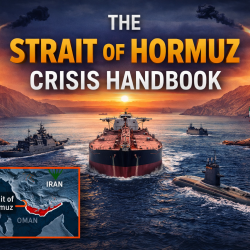
The Complete Strait of Hormuz Crisis Handbook — 2026 Edition
Eight chapters covering every dimension of the current crisis: the geography that makes the strait irreplaceable, Iran’s full military capability, the legal framework, economic modelling of three closure scenarios, and the history that explains how we got here. Written for investors, analysts, journalists, and informed citizens.
Immediate access · No subscription · One-time purchase · HormuzMonitor.com