



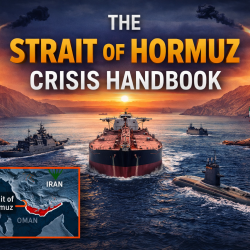

Strategic Intelligence — 2026 Edition
The Strait of Hormuz
Crisis Handbook
Geography. Oil. Military power. Economic shockwaves. Geopolitical scenarios. Everything in one place — for investors, analysts, journalists, and informed citizens.
In early 2026, the world is watching one of the most strategically consequential maritime corridors on the planet with an anxiety not felt since the Tanker War of the 1980s. Every day, an average of 17 to 21 million barrels of crude oil and refined petroleum products pass through a channel so narrow that two supertankers cannot pass abreast. That channel is the Strait of Hormuz — and whether it stays open is no longer theoretical.
This article is both a comprehensive introduction to the Strait of Hormuz Crisis Handbook (2026 Edition) and a standalone reference covering everything you need to understand the crisis. Whether you are an investor monitoring Brent crude futures, a student writing a thesis on Persian Gulf geopolitics, a journalist on deadline, or a citizen who wants to genuinely understand what the headlines mean — you are in the right place.
Contents of the Handbook
- Chapter 1 — The Geography That Changed the Worldp. 8
- Chapter 2 — The Numbers: Oil, Gas & Global Dependencyp. 14
- Chapter 3 — Iran’s Weapons: How a Closure Is Enforcedp. 21
- Chapter 4 — The Response: U.S., Allies & Naval Powerp. 29
- Chapter 5 — The Legal Battlefieldp. 36
- Chapter 6 — Economic Shockwavesp. 43
- Chapter 7 — Three Scenarios: How This Endsp. 51
- Chapter 8 — History & Context Before 2026p. 60
The Geography That Changed the World
Why a 33-kilometre channel controls the fate of the global economy
The Strait of Hormuz connects the Persian Gulf to the Gulf of Oman and the broader Arabian Sea. It lies between Iran to the north and Oman’s Musandam peninsula to the south. At its narrowest navigable point, the strait measures approximately 33 kilometres wide — but commercial tanker traffic is restricted to two three-mile inbound and outbound shipping lanes, separated by a two-mile buffer zone.
On the other side of those six miles lies the largest concentration of hydrocarbon reserves ever discovered in one geological basin: Saudi Arabia, Iraq, Kuwait, the UAE, Qatar, Bahrain, and Iran combined hold approximately 48 percent of the world’s proven crude oil reserves. Almost all of it can only reach the rest of the world through the Strait of Hormuz.
The Chokepoint Problem: No Viable Alternative
The U.S. Energy Information Administration consistently ranks Hormuz as the world’s most important maritime chokepoint — above the Suez Canal, the Strait of Malacca, Bab el-Mandeb, and all others. Alternative pipeline routes exist — Saudi Arabia’s East-West pipeline (5 million bpd capacity), the Abu Dhabi Crude Oil Pipeline — but their combined capacity represents less than a third of normal Hormuz throughput.
The Strait of Hormuz handles roughly 20–21% of global petroleum liquids consumption every day. No other chokepoint comes close. The nearest alternative — the Suez Canal — handles less than 9% of global seaborne oil trade.
Iran controls the northern shore of the strait for its entire length. From naval bases at Bandar Abbas, Qeshm Island, and the disputed islands of Abu Musa, Greater Tunb, and Lesser Tunb — seized from the UAE in 1971 — Iran can deploy assets threatening shipping at every point in the navigable lanes. These islands function as unsinkable forward operating bases at the western mouth of the strait.
The Numbers — Oil, Gas, and Global Dependency
Why the Strait of Hormuz is important for oil: the full statistical picture
The question “why is the Strait of Hormuz important for oil?” has a fuller answer than most news coverage provides. The strait is not merely a passage for Gulf oil — it is the linchpin of the entire global energy distribution system, and its importance is growing, not shrinking, despite Western optimism about the energy transition.
According to the most recent EIA data, approximately 17 to 21 million barrels of crude oil, condensate, and petroleum products transit the strait every single day — 20 percent of global petroleum liquids consumption. On any given day, between 15 and 20 supertankers are in simultaneous transit, plus dozens of product tankers, LNG carriers, and support vessels.
LNG: The Underreported Hormuz Story
Crude oil dominates headlines, but liquefied natural gas tells an equally important story. Qatar, which operates the world’s largest LNG export facilities at Ras Laffan, is entirely dependent on the Strait of Hormuz. Countries most exposed to Qatari LNG disruption include Japan, South Korea, China, India, Pakistan, and European nations that pivoted to LNG as a substitute for Russian pipeline gas after 2022. A Hormuz closure would simultaneously disrupt crude markets and global LNG markets.
Asia-Pacific nations import approximately 76% of all crude oil transiting the Strait of Hormuz. A closure would constitute an existential economic emergency for Japan, South Korea, and Taiwan — all U.S. treaty allies. It would also devastate the energy security architecture Europe built after the Ukraine war.
Even in the most aggressive energy transition scenarios, global oil demand does not fall below current Hormuz throughput levels until the mid-2030s — and that assumes policy ambition that has not been achieved in any major economy to date.
— Strait of Hormuz Crisis Handbook, Chapter 2The energy transition does not change the near-term calculus. The IEA’s Stated Policies Scenario projects global oil demand at or above 100 million barrels per day through the end of the decade — and the Gulf’s share is expected to increase as non-OPEC producers face depletion rates that Gulf producers, with their low-cost reserves, are uniquely positioned to offset.
Iran’s Weapons — How a Closure Is Enforced
The Iran oil chokepoint threat: what Tehran can actually do, and how
Understanding the Iran oil chokepoint threat requires moving beyond whether Iran would close the strait to the far more analytical question of how. Iran has spent four decades — since the end of the Iran-Iraq War in 1988 — developing a layered military capability specifically designed to deny the ability of the U.S. and its allies to keep the Strait of Hormuz open under fire.
The Islamic Revolutionary Guard Corps Navy (IRGCN) is the primary instrument of Hormuz denial — not the conventional Iranian Navy (IRIN). The IRGCN has evolved a doctrine known as ‘mosaic warfare’: combining multiple weapons systems in coordinated fashion designed to overwhelm any naval force attempting to keep the strait open.
Mines: The Most Dangerous Weapon
Iran is estimated to possess between 2,000 and 5,000 naval mines of various types — bottom mines, moored contact mines, influence mines activated by magnetic/acoustic/pressure signatures, and modern intelligent mines that can distinguish between military and commercial targets. A determined mining campaign would not need to sink a single ship to achieve its strategic objective.
During the 1988 Tanker War, the mining of the USS Samuel B. Roberts by a single Iranian mine triggered a two-week military confrontation (Operation Praying Mantis). A coordinated mass mining campaign in 2026 would present a problem of incomparably greater complexity. Mine clearance under fire is measured in weeks, not days.
The mere presence of suspected mines triggers the suspension of commercial shipping. No tanker captain, shipowner, or maritime insurer exposes a 00 million vessel to minefield passage when risk cannot be quantified. The suspension of commercial traffic therefore precedes any physical ship losses.
Fast Attack Craft, Missiles, and Submarines
The IRGCN operates several hundred fast attack craft — armed with RPGs, heavy machine guns, anti-ship missiles, and torpedoes — capable of 40–60 knots in the strait’s sheltered waters, operating in swarms of 10 to 40 vessels from dozens of concealed coastal locations. Iran’s anti-ship missile inventory includes the domestically developed Khalij Fars ballistic anti-ship missile — a manoeuvring terminal-phase weapon that challenges current U.S. Navy interceptor systems. Three Russian Kilo-class submarines complete the picture: diesel-electric, near-silent on battery, ideal for mine-laying in shallow contested waters.
The Response — U.S., Allies and the Limits of Naval Power
What happens if Iran closes the Strait of Hormuz: the military dimension
The U.S. Fifth Fleet, headquartered in Manama, Bahrain, maintains the most powerful external naval presence in the Persian Gulf — carrier strike groups, guided-missile destroyers and cruisers, attack submarines, minesweepers, and maritime patrol aircraft. The Combined Maritime Forces, a 38-nation coalition operating under Fifth Fleet direction, adds significant multinational mine countermeasures capability.
The historical precedent is Operation Earnest Will (1987–1988) — the U.S. Navy’s reflagging and escort of Kuwaiti tankers during the Tanker War. Earnest Will proved that the U.S. Navy could protect commercial shipping through a contested strait, but only at significant cost, and only while Iran was simultaneously fighting a land war against Iraq. The 2026 scenario is categorically different.
The United States has the military capability to defeat Iran in the strait. The question is not whether the U.S. can win a Hormuz engagement — it is what happens across Lebanon, Iraq, Syria, and Yemen when it does. Iran’s proxy network creates simultaneous multi-theatre risk that has no equivalent in any previous Hormuz confrontation.
Mine countermeasures capacity is the critical bottleneck. The U.S. Navy operates fourteen Avenger-class mine countermeasures vessels — a fleet criticised as inadequate for decades. A single mine-clearing team clears a lane of perhaps one to two nautical miles per day under ideal conditions. Even a combined U.S.-UK-French MCM surge would take days to weeks to assemble and deploy — during which commercial shipping would be suspended and oil prices would be spiking.
The Legal Battlefield
International law, UNCLOS, and Iran’s dissenting position
The governing legal framework is UNCLOS — the United Nations Convention on the Law of the Sea (in force 1994). Article 38 establishes the right of transit passage through international straits, a right that cannot be suspended by the bordering state. Under this framework, all ships and aircraft enjoy unrestricted transit passage through the Strait of Hormuz.
Iran has never ratified UNCLOS. Tehran operates under domestic maritime legislation that asserts the right to regulate — and in certain circumstances restrict — transit through the strait on national security grounds. This position has no standing in international law as accepted by the community of nations, but it provides Iran with a domestic legal narrative for any closure action it might undertake.
Any Iranian closure would trigger a Security Council confrontation — where Russia and China would veto any resolution authorising countermeasures. This veto dynamic means that any military response to a Hormuz closure would be legally characterised differently by different powers: as enforcement of international law by the U.S.-led coalition, and as aggression against a sovereign state by the Russia-China bloc. The legal ambiguity does not prevent military action, but it complicates the diplomatic aftermath and affects the positions of non-aligned oil consumer states in Asia.
Economic Shockwaves
The Hormuz closure effect on oil prices, GDP, and global supply chains
The Hormuz closure effect on oil prices is the dimension most directly affecting the broadest audience: investors, business owners, logistics professionals, and anyone who pays an energy bill. The economic modelling of a Hormuz closure is complex, operating through multiple transmission mechanisms simultaneously, its severity depending critically on the duration of disruption.
A 30-day Hormuz closure would constitute the largest supply disruption in the history of oil markets — dwarfing the 1973 Arab oil embargo and every subsequent disruption combined.
— Strait of Hormuz Crisis Handbook, Chapter 6The economic impacts extend far beyond crude oil markets. Petrochemical feedstocks, fertiliser production (tied to Gulf gas prices), aviation fuel, plastics, and pharmaceuticals are all downstream of the Hormuz crude supply chain. Maritime insurance rates would become prohibitive. The Baltic Dry Index, LME, and commodity markets of every description would experience cascading price effects as supply chains repriced the assumption of uninterrupted transit.
Economic modelling by the IMF, World Bank, and major investment banks suggests a 30-day closure would reduce global GDP growth by 1.0–1.5 percentage points. A 90-day closure — the scenario that emerges if conflict is not rapidly resolved — could reduce global GDP by 2.5–3.5 percentage points, tipping most major economies into recession. Japan, South Korea, and Taiwan face the most severe immediate impacts; developing economies with dollar-denominated debt face the most prolonged consequences.
Chapter 6: The Full Economic Model
Country-by-country vulnerability ranking, sector analysis, historical comparison with previous oil shocks, and portfolio guidance for investors positioning across all three scenarios.
Get the Complete HandbookThree Scenarios — How the Crisis Ends
Strait of Hormuz geopolitics 2025–2026: mapping the possible outcomes
Strait of Hormuz geopolitics in 2025 and 2026 has reached an inflection point unlike any since the Tanker War. The combination of Iranian nuclear programme developments, U.S.-Israel tensions with Tehran, regional proxy conflicts, and broader great-power realignment has created a threat environment that analysts across the spectrum rate as the most volatile in four decades. The handbook models three distinct resolution scenarios.
Managed De-escalation
Back-channel diplomacy — potentially mediated by Oman — produces a tacit understanding limiting IRGCN harassment while broader negotiations proceed. Most likely if Iran calculates that economic costs (40% of government revenue from oil exports) outweigh strategic benefits.
Extended Harassment Without Full Closure
Sustained IRGCN attacks on commercial shipping, GPS jamming, tanker seizures, and selective mine-laying — without crossing the threshold of declared closure. The exact playbook Iran executed in 2019, now with more sophisticated capabilities and less international isolation.
Full Closure and Open Conflict
Triggered most likely by an Israeli strike on Iranian nuclear facilities. Iran executes coordinated multi-domain denial: mass mining, anti-ship missile strikes, fast-attack swarms, cyber attacks on port infrastructure. U.S. military response is rapid and overwhelming — but mine clearance takes 30–90 days regardless.
History and Context
Oil supply chain Middle East disruption — what the past tells us about 2026
Every major oil supply chain Middle East disruption over the past half-century has left institutional and strategic residue that shapes today’s crisis. Policymakers in Tehran, Washington, Riyadh, and Beijing are all drawing lessons from the same historical record — and interpreting it in very different ways.
- 1973 Arab Oil Embargo: Prices quadrupled in weeks. Triggered recession, formation of the IEA, and the SPR system that remains the primary tool for absorbing supply disruptions today — but has never been designed for a disruption of Hormuz’s magnitude.
- 1984–1988 Tanker War: 400+ ships damaged or sunk. Operation Earnest Will established the principle of U.S. military protection of freedom of navigation. Operation Praying Mantis sank half the operational Iranian naval fleet in one day — shaping Iranian asymmetric doctrine ever since.
- 1990–1991 Gulf War: Demonstrated that a coalition of 34 nations could expel Iraq from Kuwait in six weeks — but also demonstrated the complexity of managing Arab coalition politics and the limits of military success in resolving underlying regional tensions.
- 2019 Gulf Tensions: Tanker attacks, Abqaiq strikes, USS drone shootdown, Stena Impero seizure. Iran’s lesson: grey-zone harassment can impose significant costs without triggering direct military retaliation. The U.S. lesson: extended deterrence has credibility gaps that adversaries will probe.
Every Hormuz crisis in history has eventually de-escalated — but none has produced a durable resolution of the underlying tensions that caused it. The structural incentives for Iranian brinkmanship — domestic political pressure, sanctions relief leverage, regional deterrence — have not changed. The current crisis is occurring in a more complex great-power environment than any of its predecessors.
Key Takeaways — And Why This Ebook Is Essential Reading Now
- The Strait of Hormuz is irreplaceable. No combination of pipelines or alternative supply sources can compensate for a closure in the near term.
- Oil dependency numbers are staggering. Twenty percent of global petroleum liquids — and a quarter of global LNG — transit the strait daily. The most exposed economies are U.S. treaty allies.
- Iran’s closure capability is real and sophisticated — built over four decades and specifically designed to defeat U.S. naval supremacy through asymmetric means.
- The mine clearance bottleneck is the decisive variable: even military victory cannot reopen the strait for weeks, and that gap is where catastrophic economic damage accumulates.
- The extended harassment scenario is the most probable near-term outcome — and it has no natural endpoint. Iran can sustain grey-zone operations for years.
- A full closure requires a triggering event of sufficient magnitude — most plausibly a direct strike on Iranian nuclear facilities. Nuclear diplomacy and Hormuz geopolitics are inseparable.
- The time to understand this crisis is before it peaks, not after. The handbook gives every stakeholder group — investors, analysts, logistics professionals, policy researchers — what they need to act.
Get the Strait of Hormuz Crisis Handbook
Eight chapters. 80,000 words. The most comprehensive open-source analysis of the Strait of Hormuz crisis available in a single volume. PDF, EPUB, and MOBI — immediate access.
Buy the Ebook Now — HormuzMonitor.comWho This Handbook Is Written For
- Investors and traders — understand Hormuz disruption effects on oil prices, energy equities, and portfolio risk (Chapters 6 & 7)
- Students and academics — international relations, geopolitics, and security studies; comprehensive, rigorously sourced reference (all chapters)
- Journalists, analysts, and policy researchers — the complete picture in one place, with primary source references throughout
- Business owners and logistics professionals — supply chain stress-testing framework and scenario-specific guidance (Chapters 6 & 7)
- Informed citizens — written in plain language without sacrificing analytical depth
Quick-Reference Glossary
Further Reading & External Sources
- U.S. Energy Information Administration — World Oil Transit Chokepoints
- International Energy Agency — Oil Security & Strategic Petroleum Reserves
- IISS Military Balance — Iranian Armed Forces Data
- UNCLOS Full Text — Part III: Straits Used for International Navigation
- Naval War College Review — Persian Gulf Strategic Studies
- HormuzMonitor — Latest Hormuz Crisis News & Intelligence
- HormuzMonitor — Interactive Strait of Hormuz Map