21M
barrels/day through Hormuz
20%
of global petroleum supply
33km
narrowest point of the strait
$200
Brent ceiling, worst-case
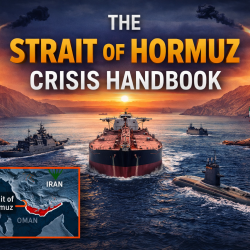
The Strait of Hormuz, a narrow waterway between Iran and Oman, is the world’s most critical oil chokepoint. Every day, approximately 21 million barrels of crude oil and refined petroleum products pass through its 33-kilometre-wide navigable channel — roughly one-fifth of total global oil consumption. Saudi Arabia, Iraq, Kuwait, the UAE, Bahrain, and Qatar all depend on the strait to export oil to world markets. A full or partial closure would create an immediate supply deficit with no short-term fix.
🛢️ Why closure triggers a price spike
Alternative routes exist — chiefly the Suez Canal, the Saudi East-West Pipeline, and the Cape of Good Hope routing — but none can absorb the full Hormuz volume quickly. The East-West Pipeline tops out at around 5 million barrels per day. Rerouting tankers around Africa adds 15–20 days of transit time, tying up shipping capacity and driving freight rates sharply higher alongside the crude price itself.
📊 How the scenarios are calibrated
Our three scenarios map to historical and forward-looking Goldman Sachs Research forecasts. Scenario 1 mirrors the price response seen during peak 2019 Houthi/drone attack periods. Scenario 2 is modelled on a hypothetical 4–8 week blockade drawing down IEA strategic reserves. Scenario 3 incorporates infrastructure strikes on onshore Saudi and UAE loading terminals, sustaining the shock for 3–6 months.
🌍 Not all countries are equally exposed
Exposure depends on where a country sources its oil imports. Japan and South Korea source ~92–95% of their crude from Gulf producers transiting Hormuz — making them severely exposed. Conversely, the United States (55% exposure) has diversified its supply heavily toward domestic production and Western Hemisphere imports since 2014. African nations like Kenya (82%) remain heavily Hormuz-dependent.
🏭 Why sector matters for cost pass-through
Different sectors feel the oil price at different intensities. Airlines operate on jet fuel with no direct substitute, so we apply a 105% pass-through (higher than crude because refined jet fuel commands a premium). Fleet operators and logistics businesses have full exposure at 100%. Households, partially buffered by government subsidies and slower retail pricing adjustments, see a modelled 85% pass-through rate.
What is the Strait of Hormuz and why does its closure matter to fuel prices?
The Strait of Hormuz is a narrow waterway between Iran and Oman that connects the Persian Gulf to the Gulf of Oman and the broader Indian Ocean. It is the world’s single most important oil transit chokepoint: roughly 20–21 million barrels per day — one-fifth of global petroleum supply — pass through it. If it were closed, even partially, the immediate loss of supply would send global oil benchmarks like Brent crude sharply higher within days, because there is no alternative route capable of absorbing the full volume on short notice. Higher Brent directly feeds into petrol, diesel, jet fuel, and electricity prices for consumers and businesses worldwide.
How does the Hormuz cost calculator work?
You enter your monthly fuel or energy spend (or daily liters consumed) and select your country and entity type. The calculator then applies three multipliers: (1) a scenario-specific Brent crude price increase derived from Goldman Sachs and IEA research, (2) your country’s Hormuz oil import exposure factor (the share of your country’s crude imports that transit the strait), and (3) a sector pass-through rate reflecting how quickly rising crude prices translate into your actual fuel bill. The result is your estimated new monthly cost and the additional annual expense under each of the three scenarios.
Which countries face the highest risk from a Hormuz closure?
Asian economies that import most of their oil from the Gulf are the most exposed. Japan (95% exposure), South Korea (92%), Singapore (88%), India (88%), and China (80%) face the sharpest potential price increases. In the Middle East itself, Jordan (90%), Lebanon (88%), and Yemen (85%) are highly exposed as they have few alternative suppliers. Many African nations including Kenya (82%) and Ethiopia (80%) also face significant pass-through because the majority of their crude imports originate in the Gulf region. Norway (20%) and Russia (5%) are least affected as they are net oil exporters.
What is the current Brent crude baseline used in this calculator?
The calculator uses a pre-conflict baseline of approximately $67 per barrel, reflecting the Brent crude spot price in February 2026 before the current period of Hormuz-related tension. All scenario price projections are expressed as percentage increases from this baseline: Scenario 1 (+30–46%, $87–98/bbl), Scenario 2 (+72–94%, $115–130/bbl), and Scenario 3 (+124–199%, $150–200/bbl).
Are there alternative shipping routes if Hormuz closes?
Yes, but they are limited in capacity and require significantly longer transit times. The Saudi East-West Pipeline (Petroline) can carry up to 5 million barrels per day to Red Sea terminals, bypassing the strait entirely. The Abu Dhabi Crude Oil Pipeline (ADCOP) can move up to 1.5 million bpd to Fujairah. Tankers can reroute around the Cape of Good Hope, but this adds 15–20 days of transit time, ties up a much larger fleet, and dramatically increases shipping costs. Together, alternative routes can only substitute for roughly one-third of normal Hormuz throughput, meaning a full closure would still create a net global supply shortfall of around 13–15 million barrels per day.
How accurate are these estimates?
These are modelled estimates based on published commodity research and publicly available trade data — not precise forecasts. Actual cost impact will vary based on your specific supplier contracts and hedging positions, government fuel subsidy policies in your country, the speed at which retail pump prices respond to wholesale crude movements, and the precise duration and severity of any closure. Businesses with commodity price hedges in place, or countries with large strategic petroleum reserves, may see materially lower pass-through than these estimates suggest. This tool is designed to give you a directionally accurate order-of-magnitude cost range for planning purposes.
METHODScenario methodology
Scenario 1
Partial disruption
$87–98/bbl (+30–46%)
Intermittent attacks, partial rerouting via Cape of Good Hope. Supply delayed 2–3 weeks. Mirrors 2019 Abqaiq-Khurais drone attack response.
Scenario 2
Prolonged closure
$115–130/bbl (+72–94%)
Full military blockade lasting 4–8 weeks. Strategic reserves partially drawn down. East-West pipeline at capacity. IEA emergency release activated.
Scenario 3
Full closure + strikes
$150–200/bbl (+124–199%)
Extended closure with infrastructure strikes on Saudi/UAE export terminals. Shock persists 3–6 months. Recession risk for oil-importing economies.
Baseline: Brent crude ~$67/bbl (pre-conflict, February 2026). Scenarios derived from Goldman Sachs Research, IEA emergency supply analysis, and forex.com commodity forecasts (March 2026). Country Hormuz exposure factors reflect share of crude imports transiting the strait per EIA bilateral trade data. Sector pass-through rates: individuals 85%, SMEs 92%, fleet operators 100%, manufacturers 97%, airlines 105% (jet fuel premium). This tool provides estimates only — actual costs depend on hedging positions, long-term supply contracts, and local fuel pricing policy. Not financial advice.