



Hormuz Dependency Score
Global oil chokepoint exposure index. Measures each nation’s vulnerability to a Strait of Hormuz disruption across four risk vectors.
EIA · IEA · BP Statistical Review
World Bank · IMF · DoE/SPR Data
LAST UPDATED
Q4 2024 / March 2025
Select a country above to calculate its exposure.
↑ TYPE OR CLICK A QUICK-PICK TO BEGIN
What Is the Hormuz Dependency Score?
The Hormuz Dependency Score (HDS) is a composite index that quantifies how exposed any country is to a disruption of oil and gas flows through the Strait of Hormuz — the world’s most critical energy chokepoint. It combines four risk vectors into a single 0–100 score: crude oil import exposure, LNG supply vulnerability, strategic petroleum reserve buffer, and macroeconomic sensitivity.
Roughly 21 million barrels of oil per day — about 21% of global petroleum consumption — transit the Strait of Hormuz. A sustained closure or partial disruption would not merely raise fuel prices: it would trigger supply rationing, currency crises, industrial shutdowns, and humanitarian emergencies across dozens of nations simultaneously. The HDS was built to make that risk legible, country by country.
Unlike narrative geopolitical assessments, the HDS is quantitative, reproducible, and comparable across all sovereign states. Whether you are a policy researcher, energy analyst, investor, or simply a curious citizen, this tool answers a single pointed question: if the Strait of Hormuz closed tomorrow, how badly would your country be hit?
The percentage of a country’s total crude oil imports that originate from, or transit through, Hormuz-adjacent producers: Saudi Arabia, Iraq, Kuwait, Iran, the UAE, and Qatar. A country sourcing 90% of its crude from Gulf states faces near-total supply disruption if the strait closes; one sourcing primarily from North Sea, West African, or Western Hemisphere producers faces mainly a price shock rather than a physical shortage.
Weight in HDS: 35%. Crude import origin is the single largest driver of physical vulnerability because refined products flow from crude — interrupt the feedstock and refinery output collapses within days.
The share of a country’s liquefied natural gas imports sourced from Gulf producers — primarily Qatar, the world’s largest LNG exporter, along with the UAE and Oman. Qatar’s LNG terminals on the eastern coast of the peninsula export exclusively through Hormuz. A closure would simultaneously cut Europe’s piped-gas alternatives, Asia’s power generation feedstocks, and global LNG spot markets.
Weight in HDS: 20%. LNG carries a slightly lower weight than crude because many importers have greater gas storage flexibility and alternative pipeline access, though for countries like Japan and South Korea, LNG exposure rivals crude exposure in severity.
The number of days a country’s Strategic Petroleum Reserve — combined with commercial stock obligations — can sustain consumption without new imports. The IEA mandates member states hold a minimum of 90 days of net import cover. Countries below this threshold face acute vulnerability within weeks of any supply disruption; those above it can coordinate international release programs and negotiate alternative supply contracts before true shortages materialize.
Weight in HDS: 25% (inverted — higher SPR days reduce the score). SPR buffer is the primary policy lever governments control directly. The United States holds the world’s largest reserve at ~170 days; Pakistan holds approximately 3 days.
A composite sub-score (0–100) measuring the macro-structural sensitivity of a country’s economy to an oil price spike and potential supply shock. Sub-components include: energy intensity of GDP, trade openness and current account position, foreign exchange reserve adequacy, fiscal oil-revenue dependence, and the substitutability of petroleum in key economic sectors (agriculture, manufacturing, transport).
Weight in HDS: 20%. Two countries with identical import exposure can face wildly different outcomes depending on whether they hold sufficient dollar reserves to finance emergency spot purchases, and whether their industrial base can absorb fuel rationing without cascading employment losses.
The World’s Most Important 33 Miles of Water
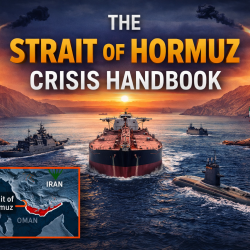
The Strait of Hormuz is a narrow waterway separating the Persian Gulf from the Gulf of Oman, bordered by Iran to the north and the United Arab Emirates and Oman to the south. At its narrowest point it is approximately 33 miles wide, with two-mile-wide shipping lanes in each direction separated by a two-mile buffer zone.
Every day, roughly 17 to 21 super-tankers pass through, carrying oil from Saudi Arabia, Iraq, Kuwait, Iran, the UAE, and Qatar to refineries and power plants across Asia, Europe, and beyond. Qatar’s entire LNG export capacity — the gas powering German factories, Japanese power plants, and South Korean petrochemical complexes — transits exclusively through Hormuz.
Historical Threat Context
The “Tanker War” of the 1980s during the Iran-Iraq conflict saw attacks on hundreds of commercial vessels in the Gulf. Iran has repeatedly threatened to close the strait in response to economic sanctions. The 2019 attacks on tankers near Fujairah, and Houthi strikes on shipping in 2023–2024, demonstrated that even the credible threat of disruption significantly moves global energy markets — a full closure would be an unprecedented economic shock.
No Easy Alternative
Saudi Arabia’s East-West pipeline (Petroline) carries approximately 5 Mb/d to Yanbu on the Red Sea — providing a partial bypass for Saudi exports only. The UAE’s Abu Dhabi Crude Oil Pipeline (ADCOP) to Fujairah has 1.5 Mb/d capacity. Combined, these bypasses cover roughly one-third of current Hormuz flows — leaving the global economy exposed for the remaining two-thirds with no realistic alternative routing.
Reading the Hormuz Dependency Score Card
Each country card shows four metrics and one composite score. Here is how to interpret them in combination rather than isolation.
High Oil + Low SPR = Critical Physical Risk
Countries like Japan (92% oil exposure, 145-day SPR) face severe disruption but have substantial time to negotiate emergency alternatives. Countries like Pakistan (72% oil exposure, 3-day SPR) face immediate physical shortages with no buffer whatsoever — supply disruption becomes humanitarian crisis within days, not weeks.
Low Oil + High LNG = Hidden Vulnerability
Some European economies appear insulated from crude disruption but face significant LNG vulnerability. Qatar supplies a large share of European regasification terminal throughput. A Hormuz closure that prevents LNG shipments would hit electricity and industrial gas markets even in countries with diversified crude sources.
Producer States: Inverted Exposure
Oil-exporting nations — Saudi Arabia, Kuwait, Qatar, Iraq, Kazakhstan, Norway — score very low on import vulnerability but face a different Hormuz risk: the inability to export. Their economic vulnerability scores reflect the fiscal shock of lost export revenues rather than supply shortages. For these countries, Hormuz closure is an economic weapon turned against themselves.
Score Tiers
80–100: Critical. Likely shortages within 30 days of closure. 60–79: High. Severe price shock, rationing risk within 60–90 days. 40–59: Moderate. Significant economic pain, manageable with emergency reserves and diversification. 0–39: Low/Minimal. Primarily price transmission effects; physical supply security maintained.
| Vector | Weight | Data Sources | Notes |
|---|---|---|---|
| Oil Import Exposure | 35% | EIA, IEA, BP Statistical Review, national customs data | Origin-based; includes transit volumes through Hormuz from non-Gulf producers where applicable. Updated annually from latest IEA World Energy Balances. |
| LNG Supply Exposure | 20% | GIIGNL Annual Report, IEA Gas Market Report, Kpler trade data | Reflects share of LNG imports from Qatar, UAE, and Oman as proportion of total gas supply. Countries with pipeline-only gas supply score near zero. |
| SPR Buffer (inverted) | 25% | IEA Oil Security, DoE/SPR data, national energy ministry reports | Measured in days of net import cover. Score = max(0, 100 − (days/200)×100). IEA 90-day minimum used as calibration benchmark. Producer nations assigned ∞ (score: 0). |
| Economic Vulnerability | 20% | World Bank, IMF WEO, IEA Energy Intensity, OECD | Composite of energy intensity, FX reserve adequacy, fiscal oil dependence, trade openness, and import substitutability. Scored 0–100 by analyst model. |
| Composite HDS | — | — | HDS = (Oil × 0.35) + (LNG × 0.20) + (SPR_score × 0.25) + (Econ × 0.20). Rounded to nearest integer. Range: 0–100. |
All 160+ countries scored in the Hormuz Dependency Index. Select any country to view its full exposure card.
The Persian Gulf Bottleneck
Six of the world’s top oil exporters — Saudi Arabia, Iraq, Iran, Kuwait, UAE, and Qatar — share a single exit point to global markets. The Strait of Hormuz is 33 miles wide at its narrowest; the navigable shipping lanes are just 2 miles wide in each direction. There is no credible alternative route for the majority of this volume: the Petroline bypass covers ~5 Mb/d of Saudi exports only, leaving 16+ Mb/d with no alternative routing.
Iran’s Closure Capability
Iran’s Islamic Revolutionary Guard Corps (IRGC) Navy maintains extensive anti-ship missile systems, fast attack craft, and sea mine capabilities specifically designed to threaten Hormuz shipping. Iran has explicitly invoked closure threats in response to sanctions pressure in 2008, 2011, 2012, 2018, and 2019. US 5th Fleet, based in Bahrain, maintains constant presence to deter and respond — but even temporary disruption lasting days would severely move global energy markets.
How Renewables Reduce — but Don’t Eliminate — Hormuz Risk
The global energy transition is gradually reducing Hormuz dependency for electricity generation as solar, wind, and nuclear replace gas-fired power plants. However, transport fuel — aviation, heavy shipping, road freight — remains almost entirely petroleum-dependent, with no credible alternative at scale before 2035 at the earliest. For most countries, the energy transition reduces gas exposure faster than oil exposure, leaving crude oil import vulnerability as the persistent chokepoint risk for the next decade.