



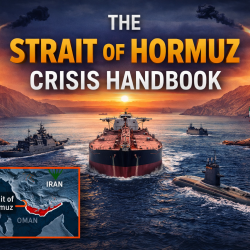
The Strait of Hormuz has a long history of tension because it sits at the intersection of energy trade, maritime strategy, and regional power politics.

The Strait of Hormuz: A History of Tensions at the World’s Most Critical Oil Chokepoint
The Strait of Hormuz, a narrow waterway connecting the Persian Gulf with the open ocean, has been a flashpoint for international tensions for decades. As the route through which approximately 20% of the world’s oil consumption passes, its strategic importance cannot be overstated. When tensions rise in this corridor, global energy markets hold their breath. This article traces the history of conflicts and confrontations that have shaped the strait’s reputation as one of the world’s most volatile maritime chokepoints.
The Strategic Jewel
Before delving into the history, it is essential to understand what makes this waterway so vital. At its narrowest point, the Strait of Hormuz is just 33 kilometers wide, with shipping lanes only 3 kilometers wide in each direction. Through this narrow passage, OPEC giants including Saudi Arabia, Iran, the UAE, Kuwait, and Iraq export the vast majority of their crude oil, primarily to Asian markets. Qatar also sends almost all of its liquefied natural gas (LNG) through these waters.
Iran has long considered the strait within its sphere of influence. In 1959, Iran changed the legal status of the strait by expanding its territorial waters to 12 nautical miles. Oman followed suit in 1972, effectively meaning the strait became enclosed by the joint territorial waters of the two nations. Since the 1970s, Iran has maintained a military presence on the strait’s key islands, positioning itself as the gatekeeper of this strategic artery.
The Tanker War: 1980-1988
The most significant historical precedent for today’s tensions came during the Iran-Iraq War (1980-1988), when the conflict spilled into the waters of the Persian Gulf in what became known as the “Tanker War.”
Iran’s Three Threats to Close the Strait
Throughout the eight-year conflict, Iran issued at least three major threats to block the strait, each sending shockwaves through global oil markets.
The first threat came in 1982, when Iran’s ground offensive into Iraq stalled. Seeking to pressure Saudi Arabia, Kuwait, and other Gulf Arab states that were financially supporting Iraq, Tehran warned in June 1982 that if they continued backing Baghdad, “the Strait of Hormuz will no longer be safe for oil transport.” The impact was immediate: Brent crude jumped from $34 to $39 per barrel, while U.S. crude futures trading volume surged 30% in a single day. The United States began coordinating strategic petroleum reserve releases, and European nations accelerated North Sea oil purchases to reduce Gulf dependence.
The second threat emerged in 1984 as the Tanker War intensified. After Iraq began attacking Iranian oil tankers, Iran’s Revolutionary Guards warned in February: “If Iraq continues striking our oil installations, we will close the Strait of Hormuz and make the world see the cost.” This prompted lasting structural changes in global energy infrastructure. Saudi Arabia launched a massive “overseas storage program,” building a 1,200-kilometer east-west pipeline and stockpiling over 80 million barrels at Red Sea and Mediterranean terminals. The UAE constructed a pipeline connecting its inland fields to Fujairah port on the Gulf of Oman, bypassing the strait entirely.
The third phase began in 1986, when Iran combined threats with action. Beyond rhetoric, Iranian forces attacked Kuwaiti tankers—retaliation for Kuwait allowing Iraq to use its ports. International criticism mounted as commercial vessels came under indiscriminate attack. By January 1986, oil prices hit $45 per barrel, the war’s peak, as industrial powers frantically built reserves.
The Mine Warfare Legacy
A particularly dangerous dimension of the Tanker War was Iran’s extensive use of naval mines—a weapon one European news outlet called “the poor man’s weapon” that can disable a billion-dollar warship for a fraction of the cost.
Iran laid minefields stretching from the Persian Gulf through the Strait of Hormuz to the approaches of Fujairah and Bahrain, home to the U.S. Navy’s base. The danger became tragically clear in July 1987, when the supertanker SS Bridgeton—part of the first U.S.-escorted convoy of reflagged Kuwaiti tankers—struck an Iranian mine near Farsi Island, tearing a massive hole in its hull. Though the vessel survived and completed its voyage, the incident exposed the vulnerability of even protected shipping.
The threat to U.S. warships materialized in April 1988, when the guided-missile frigate USS Samuel B. Roberts struck a mine in the same vicinity. The explosion blew a hole in the hull, flooded lower decks, ignited fires, and injured several sailors. The ship nearly sank.
Operation Praying Mantis: America’s Response
The mining of the Roberts triggered the largest U.S. naval surface engagement since World War II. On April 18, 1988, the Reagan administration launched Operation Praying Mantis, a one-day battle that saw American forces destroy two Iranian warships, up to six armed speedboats, and two offshore oil platforms that Washington alleged were being used to launch attacks. The message was unmistakable: threatening the free flow of oil would invite devastating retaliation.
Tragedy in the Sky
Just three months later, on July 3, 1988, the USS Vincennes—a guided-missile cruiser patrolling the Gulf—shot down Iran Air Flight 655, killing all 290 passengers and crew aboard. Washington claimed the crew mistook the civilian Airbus for an Iranian F-14 fighter. Tehran condemned it as a deliberate attack. To this day, the incident remains a deep wound in Iranian memory and a stark reminder of how quickly tensions can spiral.
Sailors’ Stories from the Danger Zone
For the merchant mariners who sailed these waters during the Tanker War, the memories remain vivid. Captain Jamshed Appoo, who traversed the strait numerous times as chief officer on Very Large Crude Carriers (VLCCs), recalled the harrowing precautions: “Darkness became our ally.” His vessel sailed with radars and navigation lights mostly off, portholes covered with black paper. Iranian gunboats stalked the shipping lanes. “I saw a vessel get hit and turn into a ball of fire just five miles ahead. So many years, and that inferno still blazes in my mind,” he told an interviewer in 2026.
Post-War Flashpoints and Continuing Tensions
The end of the Iran-Iraq war did not end the Strait’s volatility. Key incidents include:
- July 1988: USS Vincennes shoots down Iran Air Flight 655, killing 290.
- March 2007: Iran’s Revolutionary Guards seize 15 British naval personnel at gunpoint near the Gulf, claiming they were in Iranian waters.
- September 2007: The U.S. military reveals Iran built a high-tech spy post on a former crane platform to track Western naval movements.
- January 2012: Iran threatens to block the strait in retaliation for U.S. and European sanctions.
- May 2019: Four vessels, including two Saudi tankers, are attacked off Fujairah just outside the strait.
- July 2021: An Israeli-managed tanker is attacked off Oman’s coast; Israel blames Iran.
- 2023–2024: Iran seizes three vessels near or in the strait.
- June 2025: Two tankers collide and catch fire near the strait amid reports of electronic interference.
Today’s Escalating Risks
As of March 2026, the Strait of Hormuz is once again at the center of a major confrontation. Following U.S. and Israeli strikes on Iran, Tehran’s new Supreme Leader declared the strait must remain closed as leverage. The waterway has been effectively closed since February 28, 2026, with the Revolutionary Guards threatening missile and drone attacks on any ship attempting passage.
A More Dangerous Strait
Experts warn that today’s risks far exceed those of the 1980s. While Iran’s capabilities during the Tanker War were largely limited to mines, small boats, and rudimentary anti-ship missiles, the picture today is dramatically different:
- Missile Arsenal: Iran now possesses various anti-ship missiles with ranges of hundreds of kilometers, including supersonic and ballistic variants—capabilities that simply did not exist in the 1980s.
- Drone Warfare: The fleet of “Shahed” kamikaze drones, reconnaissance drones, and attack drones can overwhelm defenses through mass, low-cost swarms.
- Maritime Drones: Unmanned explosive boats, similar to those used effectively in the Ukraine war, pose a new and potent threat to both warships and tankers.
- Mine Inventory: The U.S. Defense Intelligence Agency estimated in 2019 that Iran possessed over 5,000 naval mines, including sophisticated contact, magnetic, acoustic, and “smart” mines that can be rapidly deployed by small fast boats.
Combine these capabilities with the strait’s geography—narrow shipping lanes just kilometers wide—and the potential for simultaneous mine, missile, and drone attacks could paralyze maritime traffic completely.
The Dilemma of Protection
During the Tanker War, the United States launched Operation Earnest Will (1987-1988) to escort reflagged Kuwaiti tankers. Despite U.S. Navy protection, attacks continued, and American warships were themselves damaged. Today, replicating such an operation would be exponentially more dangerous.
German Defense Minister Boris Pistorius articulated the dilemma bluntly in mid-March 2026, rejecting a U.S. request for European naval support: “What does Trump expect a couple of European escort ships to achieve in the Strait of Hormuz? Does he believe those ships can accomplish what the mighty U.S. Navy itself cannot?” The Washington Post observed that “few nations will go where the U.S. Navy does not.”
Historical Echoes: Comparing with the Suez Crisis
Several commentators have drawn parallels between the current crisis and the 1956 Suez Crisis, when Egyptian President Gamal Abdel Nasser’s nationalization of the Suez Canal triggered a failed invasion by Britain, France, and Israel.
Then, as now, a strategic chokepoint became the focus of great power confrontation, with global energy supplies at stake. The Suez Crisis marked the end of Franco-British dominance in the Middle East. Some analysts speculate that the current crisis could similarly reshape the region’s balance of power, potentially drawing in China as a new player.
Indian politician Jairam Ramesh noted the irony that the same U.S. leadership that opposed the Suez adventure had, just three years earlier, backed the 1953 coup in Iran that overthrew its democratically elected government—a reminder of how historical currents intertwine.
Conclusion: A Perpetual Flashpoint
For over four decades, the Strait of Hormuz has been an arena where military power, energy security, and geopolitical rivalry converge. Iran has repeatedly used the threat of closure as asymmetric leverage—a tool to compensate for conventional military inferiority. Yet Iran itself remains vulnerable: over 90% of its own oil exports pass through the strait, giving it a powerful incentive to avoid actually following through on its threats.
The international community has developed coping mechanisms over the years: strategic pipelines, offshore storage, diversified suppliers, and coordinated reserve releases. But as the events of 2026 demonstrate, no amount of preparation can fully neutralize the risks when a narrow waterway carrying a fifth of the world’s oil becomes a war zone.
As Captain Appoo’s haunting memory of a ship turning into “a ball of fire” reminds us, the stakes are not just abstract matters of barrels and benchmarks. They involve real sailors, real ships, and real lives caught in the crossfire of a struggle that shows no sign of ending. The history of the Strait of Hormuz is a history of tensions managed but never resolved—a pattern that seems likely to continue for decades to come.